
Coffee talks
Friday 02/10/2026 @ 11:30, Sala riunioni quarto piano e on-line (meet.google.com/sue-bwvk-axf)
Chiara Bartolini (INAF-IRA), "Multi-wavelength observations of blazars' jets"
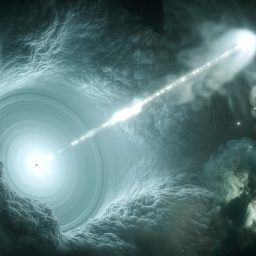
Relativistic jets in Active Galactic Nuclei (AGN) are among the most powerful sources of radiation in the Universe. The radiation spans the electromagnetic spectrum from radio to gamma-rays. Blazars are radio-loud galaxies whose jet is aligned with the line of sight. Hence, the emission is strongly beamed by relativistic Doppler effects, and their Spectral Energy Distribution (SED) is dominated by non-thermal jet emission. During my Ph.D., I analyzed 15 years of multi-wavelength emission of the FSRQ OP 313 using data from Fermi-LAT, Swift (XRT and UVOT), and VLBA radio visibilities from projects such as MOJAVE and VLBA-BU-BLAZAR. A major focus was the kinematic study of new radio components arising in blazars’ jets from VLBA images, some of which trigger gamma-ray flares. I calculated the ejection epochs and standing-shock interaction dates of these knots and modeled the broadband SEDs of the flaring events. As a CTAO consortium member, I performed sensitivity studies for Supernova Remnants (SNRs) and FSRQ observations. In particular, I simulated low- and high-redshift FSRQs jointly fitted with Fermi-LAT data across CTAO array configurations using gammapy. These simulations showed that CTAO’s enhanced sensitivity above 10 GeV provides superior spectral parameter estimation compared to existing experiments. Specifically, adding 9 Medium-Sized Telescopes (MSTs) to the 4 Large-Sized Telescopes (LSTs) in CTAO-North will not improve FSRQ detection, spectral parameter estimation, or model discrimination. This conclusion applies specifically to soft-spectrum sources and cannot be generalized to all extragalactic science.