
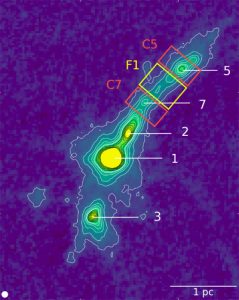
A. Image of dust emission in G351.77-0.51, a filamentary star-forming region, obtained using observations with the Large APEX Bolometric Camera at 870 microns.
Star formation and galactic radio astronomy
Regions of our Galaxy where cold (10–20 K) interstellar gas, composed primarily of molecular hydrogen, condenses to densities of the order of 1000–10,000 particles per cubic centimeter represent the birthplaces of new generations of stars. Because young stars form within clumps of gas and dust from which they accrete their mass, and which are opaque to visible light, these early stages of stellar evolution can be studied primarily through observations in the radio and (sub-)millimeter bands. At IRA, emission from complex and relatively abundant molecules in protostellar environments, such as NH₃, H₂CO, and CH₃OH, is analyzed to understand the dynamical processes and physical conditions governing star formation, on spatial scales ranging from tens of thousands to a few AUs from nascent stars.
The Institute of Radio Astronomy is involved in the following projects on the study of star formation and galactic radio astronomy: