
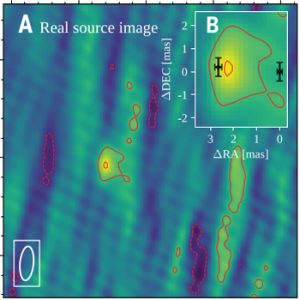
Immagine radio della controparte elettromagnetica dell’onda gravitazionale GW170817, realizzata con la rete VLBI globale
Transients
Fast Radio Bursts (FRBs) are extremely short bursts (lasting a few milliseconds) of radio emission, characterized by very high dispersion measurements, far exceeding the expected contribution from our Galaxy in the direction of observation. This indicates their extragalactic origin. Since their unexpected discovery at the beginning of this century, FRBs have represented one of the main enigmas of contemporary astrophysics. It is still unclear whether they constitute a homogeneous class of phenomena or whether they require a more detailed classification.
To understand their nature, it is essential to expand the sample of observed FRBs, thus determining their statistical properties (brightness distribution, spectral characteristics, and repetition rate) and comparing them with theoretical models. The Northern Cross Interferometer is currently being used to increase the number of known FRBs, taking advantage of its ability to rapidly observe large regions of the sky. Although most observed FRBs are single events, consistent with catastrophic scenarios, the number of repetitive sources is growing. Repeating FRBs are particularly valuable because they allow targeted observations at high angular resolution, for example using the VLBI technique, which allows for precise determination of their position in the sky. Accurate localization is a key step in identifying the host galaxy and studying its surrounding environment, providing crucial clues to the origin of the phenomenon and its physical properties.
To understand their nature, it is essential to expand the sample of observed FRBs, thus determining their statistical properties (brightness distribution, spectral characteristics, and repetition rate) and comparing them with theoretical models. The Northern Cross Interferometer is currently being used to increase the number of known FRBs, taking advantage of its ability to rapidly observe large regions of the sky. Although most observed FRBs are single events, consistent with catastrophic scenarios, the number of repetitive sources is growing. Repeating FRBs are particularly valuable because they allow targeted observations at high angular resolution, for example using the VLBI technique, which allows for precise determination of their position in the sky. Accurate localization is a key step in identifying the host galaxy and studying its surrounding environment, providing crucial clues to the origin of the phenomenon and its physical properties.
The Institute of Radio Astronomy is involved in the following projects on the study of transients: