
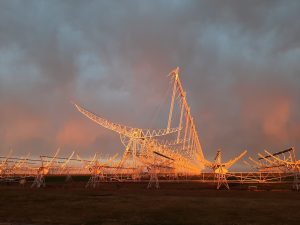
Il Radiotelescopio Croce del Nord di Medicina (BO), Italy
Planetary surveillance and defense
Since the beginning of the space age in the 1960s, Earth’s orbits have been progressively populated with artificial satellites. The increase in space traffic has inevitably also led to the growth of space debris, popularly known as “space junk.”
Orbiting objects larger than 10 centimeters in size are tracked and cataloged by space surveillance networks: by 2026, there were over 50,000, a number that is constantly growing. Alongside these monitored objects, there is a much larger population of fragments too small to be detected by current surveillance systems, generated primarily by collisions and explosions in orbit. Statistical estimates indicate over 140 million objects larger than a millimeter in size. Every piece of space debris, even a millimeter, can pose a risk: in orbit, objects reach speeds of up to 28,000 km/h, enough to cause significant damage to satellites and spacecraft and pose a danger to astronauts engaged in extravehicular activities.
Added to this is the issue of uncontrolled reentries into the atmosphere. Every year, several hundred objects with a mass greater than 500 kg reenter the Earth’s atmosphere and, in the vast majority of cases, disintegrate almost completely at high altitude. The probability of significant fragments reaching the ground is extremely low, and the risk to the population is very low. Reentries are nevertheless monitored and analyzed to assess their evolution and manage any critical issues.
Orbiting objects larger than 10 centimeters in size are tracked and cataloged by space surveillance networks: by 2026, there were over 50,000, a number that is constantly growing. Alongside these monitored objects, there is a much larger population of fragments too small to be detected by current surveillance systems, generated primarily by collisions and explosions in orbit. Statistical estimates indicate over 140 million objects larger than a millimeter in size. Every piece of space debris, even a millimeter, can pose a risk: in orbit, objects reach speeds of up to 28,000 km/h, enough to cause significant damage to satellites and spacecraft and pose a danger to astronauts engaged in extravehicular activities.
Added to this is the issue of uncontrolled reentries into the atmosphere. Every year, several hundred objects with a mass greater than 500 kg reenter the Earth’s atmosphere and, in the vast majority of cases, disintegrate almost completely at high altitude. The probability of significant fragments reaching the ground is extremely low, and the risk to the population is very low. Reentries are nevertheless monitored and analyzed to assess their evolution and manage any critical issues.
The Institute of Radio Astronomy is involved in the following projects on planetary surveillance and defense: