
 Galaxies and galaxy evolution
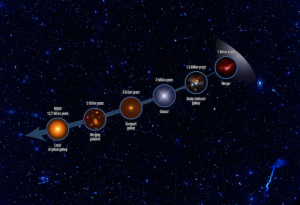
Extragalactic radio surveys are emerging as a fundamental tool for studying the formation and evolution of galaxies and supermassive black holes (SMBHs). Deeper radio observations allow the detection of star-forming galaxies and low-power active galactic nuclei (AGN) down to redshifts z ~ 2–3, i.e., when the Universe was only a few billion years old.
Thanks to new-generation radio interferometers such as LOFAR, ASKAP, and MeerKAT, it is possible to explore increasingly larger volumes of the Universe, studying the role of the environment in the growth of galaxies and SMBHs and tracing rare populations such as high-redshift radio galaxies. The latter represent invaluable tools for investigating the emergence of radio-emitting AGN in the most remote epochs (z > 7). For many years, IRA has been involved in deep radio surveys of the main extragalactic cosmological fields (COSMOS, Lockman Hole, GOODS-N) and plays a leading role in international surveys conducted with the precursor telescopes of the SKA project. The Institute is also actively involved in the analysis of data at multiple wavelengths (radio, infrared, submillimeter, optical, and X-rays).
IRA also contributes to the development of theoretical models capable of interpreting radio and infrared observations of galaxies and AGN, which are also used to simulate the performance of future instruments such as the SKA project and the Origins Space Telescope, as well as large space observatories already in operation, such as the James Webb Space Telescope.
Thanks to new-generation radio interferometers such as LOFAR, ASKAP, and MeerKAT, it is possible to explore increasingly larger volumes of the Universe, studying the role of the environment in the growth of galaxies and SMBHs and tracing rare populations such as high-redshift radio galaxies. The latter represent invaluable tools for investigating the emergence of radio-emitting AGN in the most remote epochs (z > 7). For many years, IRA has been involved in deep radio surveys of the main extragalactic cosmological fields (COSMOS, Lockman Hole, GOODS-N) and plays a leading role in international surveys conducted with the precursor telescopes of the SKA project. The Institute is also actively involved in the analysis of data at multiple wavelengths (radio, infrared, submillimeter, optical, and X-rays).
IRA also contributes to the development of theoretical models capable of interpreting radio and infrared observations of galaxies and AGN, which are also used to simulate the performance of future instruments such as the SKA project and the Origins Space Telescope, as well as large space observatories already in operation, such as the James Webb Space Telescope.
The Institute of Radio Astronomy is involved in the following projects on the study of galaxies and galaxy evolution: