

Dissecting super-massive black holes in space and time with the Event Horizon Telescope and ALMA
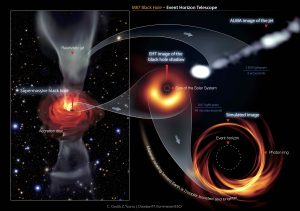
Goddi et al. 2019, ESO messenger 177-25-35
The Event Horizon Telescope (EHT) has made history with the first image of a black hole (EHTC et al., 2019a) and the first measurements of magnetic fields at the edge of a supermassive black hole (SMBH; EHTC et al., 2021a). These groundbreaking results have been possible thanks to the inclusion in the global EHT network of ALMA -the most powerful radiotelescope in the world at (sub)mm wavelengths as a phased array (Goddi et al. 2019a,b; Goddi et al. 2021).
The proposed project aims to use ALMA to study the time-variable polarization of the synchrotron emission at mm wavelengths. The latter encodes information about the magnetic fields and plasma densities from kpc along AGN jets down to their launching regions, in the vicinity of the event horizon of the driving SMBHs.
For this purpose, we exploit a unique database acquired during multiyear observational campaigns (2017-2022) with the EHT and ALMA simultaneously (>200 hours). Our sample includes chiefly the two EHT key science targets, the SMBH candidate at the Galactic center, Sgr A*, and the nucleus of the giant elliptical galaxy M87, which enable studies at horizon-scale resolution (EHTC et al. 2019a) as well as a sample of about 20 radio-loud AGN.
In this study, we combine for the first time polarization and time domain analysis to characterize the time variability of magnetic fields in the plasma accreting onto SMBHs and permeating relativistic jets in AGNs. Given that these ALMA data provide critical information for validation of VLBI data and unique constraints to theoretical models, this project is timing and essential to ensure the timely publication of the upcoming EHT results.
At its completion, this project will give a unique contribution to the EHT science and in general to advancing SMBH and AGN science.
Planned activities:
Scientific results from this work will be delivered in the form of numerous refereed publications in leading astronomical journals.
• Training of the postdoctoral fellows on the software tools and methods described in the proposal;
• Complete static analysis of the full polarization database;
• Complete time-dependent analysis of the full polarization database;
• Time-domain modeling of the polarized emission from Sgr A*, M87, and AGN;
• Magnetic field characterisation of the M87 jet at mm wavelength from a multi-year polarization monitoring with ALMA;
• Polarimetric and Faraday properties of AGN from a multi-year polarization monitoring with ALMA;
• Polarization variability of the mm emission of Sgr A* with ALMA;
• Modelling the accretion flow of Sgr A* from polarization variability with ALMA;
• Organization of a serie of seminars on polarization properties of EHT targets;
• Public release of the data in a dedicated archive;
• Outreach activities, including public talks and participation in science festivals.
Start: 28/09/2023
Duration: 29 months
Financing program: PRIN 2022 (Progetti di ricerca di Rilevante Interesse Nazionale, bando 104 del 02-02-2022)
Referent: Elisabetta Liuzzo (IRA), Ciriaco Goddi (UniCa, PI)
Collaborators: Nicola Marchili, Kazi Rygl, Alejandro Mus, Ivano Baronchelli, Rocco Lico, Mariafelicia De Laurentis
The proposed project aims to use ALMA to study the time-variable polarization of the synchrotron emission at mm wavelengths. The latter encodes information about the magnetic fields and plasma densities from kpc along AGN jets down to their launching regions, in the vicinity of the event horizon of the driving SMBHs.
For this purpose, we exploit a unique database acquired during multiyear observational campaigns (2017-2022) with the EHT and ALMA simultaneously (>200 hours). Our sample includes chiefly the two EHT key science targets, the SMBH candidate at the Galactic center, Sgr A*, and the nucleus of the giant elliptical galaxy M87, which enable studies at horizon-scale resolution (EHTC et al. 2019a) as well as a sample of about 20 radio-loud AGN.
In this study, we combine for the first time polarization and time domain analysis to characterize the time variability of magnetic fields in the plasma accreting onto SMBHs and permeating relativistic jets in AGNs. Given that these ALMA data provide critical information for validation of VLBI data and unique constraints to theoretical models, this project is timing and essential to ensure the timely publication of the upcoming EHT results.
At its completion, this project will give a unique contribution to the EHT science and in general to advancing SMBH and AGN science.
Planned activities:
Scientific results from this work will be delivered in the form of numerous refereed publications in leading astronomical journals.
• Training of the postdoctoral fellows on the software tools and methods described in the proposal;
• Complete static analysis of the full polarization database;
• Complete time-dependent analysis of the full polarization database;
• Time-domain modeling of the polarized emission from Sgr A*, M87, and AGN;
• Magnetic field characterisation of the M87 jet at mm wavelength from a multi-year polarization monitoring with ALMA;
• Polarimetric and Faraday properties of AGN from a multi-year polarization monitoring with ALMA;
• Polarization variability of the mm emission of Sgr A* with ALMA;
• Modelling the accretion flow of Sgr A* from polarization variability with ALMA;
• Organization of a serie of seminars on polarization properties of EHT targets;
• Public release of the data in a dedicated archive;
• Outreach activities, including public talks and participation in science festivals.
Start: 28/09/2023
Duration: 29 months
Financing program: PRIN 2022 (Progetti di ricerca di Rilevante Interesse Nazionale, bando 104 del 02-02-2022)
Referent: Elisabetta Liuzzo (IRA), Ciriaco Goddi (UniCa, PI)
Collaborators: Nicola Marchili, Kazi Rygl, Alejandro Mus, Ivano Baronchelli, Rocco Lico, Mariafelicia De Laurentis
For further information: ALMABHs