
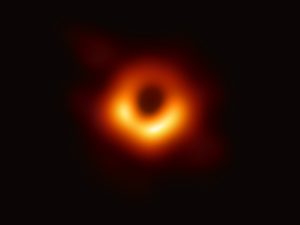
The supermassive black hole at the center of Messier 87. Credit: The Event Horizon Telescope
Supermassive BHs, relativistic jets, and radio galaxies
Black holes are extremely compact objects in which a large amount of mass is concentrated in a very small region of space. Their gravitational pull is so intense that nothing, not even light, can escape beyond a boundary called the event horizon.
If black holes are located in a gas-rich environment or in a binary system with a companion star, they can accrete matter. The infalling material forms an accretion disk that heats up to high temperatures, emitting radiation, particularly X-rays and gamma rays. Because X-rays are absorbed by the Earth’s atmosphere, studying these emissions requires the use of space satellites.
There are two main families of black holes:
• Stellar black holes, with masses ranging from a few to several dozen times the mass of the Sun, represent the final outcome of the evolution of very massive stars. When these stars exhaust their nuclear fuel, their outer layers can be expelled in a supernova explosion, while the core gravitationally collapses to form a black hole;
• Supermassive black holes, with masses ranging from millions to billions of times that of the Sun, are thought to be present at the centers of most galaxies, including the Milky Way. Their origin is still a matter of study: current models predict a progressive growth of smaller black holes through accretion and mergers with other black holes over billions of years, until they reach the masses of supermassive holes.
The Institute of Radio Astronomy is involved in the following projects on the study of supermassive BHs, relativistic jets and radio galaxies: